
On the evening of 12 August, the whole of the UK will see its most dramatic partial solar eclipse in nearly three decades.
The same eclipse will be visible across Europe and some will enjoy the ultimate solar spectacle: a total solar eclipse.
Millions are expected to gather in northern Spain and on the west coast of Iceland, hoping clear skies will allow them to experience an awe-inspiring event as the Sun, the Moon and the Earth line up in space.
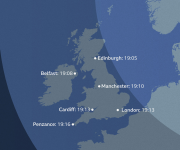
If the skies stay clear of clouds, the best views of this partial eclipse will be in the west.
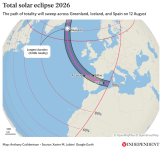
You will not see a full eclipse in the UK as the path of totality passes at sea off the south-west coast.
But the entire UK will be covered by the partial shadow of the Moon, with people in Cornwall and Pembrokeshire seeing about 95% eclipse, and most of the country seeing about 90% coverage.
Starting near the North Pole before tracking south, totality will last up to two minutes and 18 seconds.
It will take 1 and a half hours for the umbra, or moon's sun-blocking shadow, to race along the 5,130-mile (8,260-kilometer) course, most of it over an empty Atlantic. The spectacle will end in the Mediterranean.
The same eclipse will be visible across Europe and some will enjoy the ultimate solar spectacle: a total solar eclipse.
Millions are expected to gather in northern Spain and on the west coast of Iceland, hoping clear skies will allow them to experience an awe-inspiring event as the Sun, the Moon and the Earth line up in space.
If the skies stay clear of clouds, the best views of this partial eclipse will be in the west.
You will not see a full eclipse in the UK as the path of totality passes at sea off the south-west coast.
But the entire UK will be covered by the partial shadow of the Moon, with people in Cornwall and Pembrokeshire seeing about 95% eclipse, and most of the country seeing about 90% coverage.
Starting near the North Pole before tracking south, totality will last up to two minutes and 18 seconds.
It will take 1 and a half hours for the umbra, or moon's sun-blocking shadow, to race along the 5,130-mile (8,260-kilometer) course, most of it over an empty Atlantic. The spectacle will end in the Mediterranean.